
“Kwant’s piece collapses the time-space distance between slavery past and present, bringing the two into dialogue and re-inscribing forgotten legacies back onto the British landscape.”
— Sara Jaspan (2019)
Am I not a Woman and a Sister (2018-2019)
A research-led, socially engaged project co-created in collaboration with female survivors of modern slavery in partnership with national charity City Hearts, The International Slavery Museum, and British Barbadian choreographer Magdalen Bartlett-Luambia.
The work includes a four screen film installation with commissioned soundtrack by Sarah Sarhandi and accompanying texts.
(Four channel HD film, stereo sound, 13.48 mins).
Am I not a Woman and a Sister is a new moving image installation co-created with female survivors of modern day slavery in partnership with Liverpool charity City Hearts.
The work is the culmination of a year long project researching in the archives of the Merseyside Maritime Museum and the International Slavery Museum Liverpool, seeking to better understand the history of the trans-Atlantic slave trade and it’s connections to the North West of England - Kwant’s birthplace and the place she calls home.
Through her past work ‘In- Transit' - where the artist embodied and retold migrants stories through site specific performances staged across the Mediterranean - Kwant became interested in the therapeutic benefits of theatre for survivors of trauma. The artist initiated a series of movement workshops in collaboration with British- Barbadian Choreographer Magdalen Bartlett Luambia, giving female survivors of modern day slavery tools and agency to create their own performances.
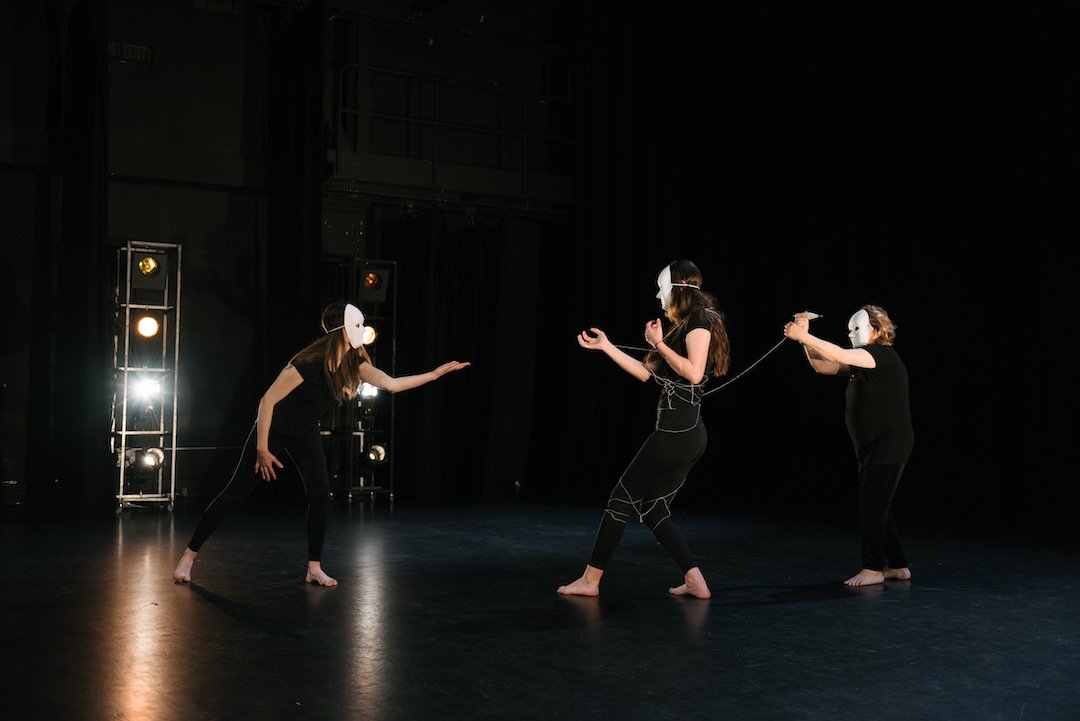
These embodied performances were shot progressively in a studio and then on location at Harewood House, built between 1759-1771 for wealthy plantation and slave owner Edwin Lascelles, 1st Baron Harewood. Through objects, actions, sound, and repetitive movements, the film reflects upon colonial slavery and its ongoing legacy in modern Britain, raising questions of colonial history and human trafficking today.
The film is complimented by a specially commissioned soundtrack composed by musician Sarah Sarhandi. The project will be accompanied by a publication documenting the workshops including; a forward by acting curator of the International Slavery Museum Jean- Francois Manicom, a commissioned text by independent writer Sara Jaspan, behind the scenes photographs and transcribed conversations with the female participants.
Supported with public funding through Arts Council England in partnership with The International Slavery Museum Liverpool and City Hearts.
Articles
“Am I not a woman and a Sister?” Article by Sara Jaspan, published in the accompanying exhibition catalogue, 2020.
“Surveying the Land: Legacies of Slavery” published by Artway, Feb 2020
Interview with Jonathan Evens, Artlyst, June 2020.
Press
‘Slavery museum in Liverpool aims to confront painful legacy’ article by Russell Contreras (The Associated Press), published in The New York Times, The Washington Times, The Washington Post, Gulf Today, US News, Concord Monitor, The Jamaica Gleaner (December 18th 2019).
“What’s New?” BBC Africa, Episode 74, Dec 2019
BBC Radio Merseyside, Interview on ‘Upfront’ with Ngunan Adamu and curator Jean- Francois Manicom, 15th Dec 2019.
“Taking a look at modern slavery: exhibition at city's dockside museum provides welcome voice for contemporary victims” by Lorna Hughes, Liverpool Echo, 31st Dec 2019.
ITV Granada News, Friday 15th Nov 2019.
"Modern day slavery put in spotlight" article by Lewis Batty, John Moores Journalism, 20th Nov 2019.
Related works Volta do Mar, Toile du Transatlantique, Broken Punch Bowls, Volta do Mar Prints
Am I not a woman and a sister (excerpt) Four channel film installation with stereo sound © Elizabeth Kwant 2019. Sound © ℗ Sarah Sarhandi. 13.48 mins. 2018- 2020
With Thanks…
The women* (To protect their identity the women who participated have not been named.) Jean Francois Manicom (Acting Curator, The International Slavery Museum), Beth Piner (Health & Wellbeing Coordinator, City Hearts), Steve Watson (North West Regional Manager, City Hearts), Magdalen Bartlett Luambia (Choreographer), Ana Lucia Ceuvas (Armadillo Productions), Fred Coker (Armadillo Productions), David Lascelles (8th Earl of Harewood), Diane Howse (Countess of Harewood), Nicola Stephenson (Exhibitions and Projects Producer, Harewood House Trust), Mark Devereux Projects (Artist’s Professional Development Mentoring), Sara Jaspan (Independent writer), Sarah Sarhandi (Musician, composer), Hannah Beatrice (Photographer), Clare Brown (Quarry Bank Mill, The National Trust), Z-Arts Theatre, Bethan Wilson.




Exhibition Essay
Am I Not a woman and a sister
by Sara Jaspan
For many people living in the UK, it is possible to feel distanced from the history of slavery. To view the trade in human flesh only as something terrible that took place a long time ago on faraway shores. As something that holds little relevance to our lives today.
Sadly, this perception is false.
Modern Britain was founded upon wealth generated by the transatlantic slave trade, the legacy of which lives on, tightly interwoven with the material and social fabric of our society. It lingers on our streets named after rich plantation owners. It resides within the walls of many of our top universities, banks and other major institutions, whose investors made their money through slave ownership. It haunts the family lineage of our current and former leaders, such as David Cameron. It underpins our sustained culture of racism and structural inequality.
That this history has been so easily overlooked is no accident. It has been obscured historically by euphemisms such as ‘plantation owner’ and ‘West Indies merchant’. Just as it is overshadowed in current public discourse by the emphasis on Britain’s role in bringing about abolition. Abolition, rather than the preceding 270-year-period during which it was one of the leading slave-trading nations. Or the £20m (£2.4bn in today’s money) it awarded to 47,000 slave-owning British citizens in 1833 in compensation for their – eventually – liberated ‘property’. Taxpayers were still repaying the loan taken out by the government to cover the financial sum up until 2015.
Slavery also continues to play a part in our lives in another invisible way. A report published by the global slavery index estimated that around 136,000 people in the UK were living as slaves in 2017 and that £14bn worth of imported goods (mostly laptops, mobile phones and clothing) were likely to have been made using slave labour. In fact, modern slavery has become a pervasive, if largely undetected, presence within British society, fuelled by the same consumerist demands and ingrained system of global wealth inequality first created by the transatlantic slave trade centuries ago.
Artist Elizabeth Kwant’s 13-minute-long looping film installation, Am I Not a woman and a sister (2019), asks us to quietly acknowledge and bear witness to these uncomfortable realities. It was co-created with female survivors of modern slavery trafficked to the UK and uses objects, gestures, locations and sounds that relate to the transatlantic slave trade and its particular connection with the north west of England. (The region from where tens of thousands of ships once departed for Africa to trade goods for people, where imported slave-produced cotton was woven in countless textile factories, and where significant wealth was accrued as a result.) In this way, Kwant’s piece collapses the time-space distance between slavery past and present, bringing the two into dialogue and re-inscribing forgotten legacies back onto the British landscape.
Acknowledging such connections is important. How else can we hope to fully engage with some of the most deep-rooted problems of our time or disrupt history’s reoccurring patterns?
+++
Kwant has engaged directly with issues of migration, immigration, legacies of colonialism, and modern slavery throughout her practice. For example, her project In-Transit (2018) took the form of a series of site-specific performances in which she physically embodied positions adopted by people journeying along the primary western migration route into Europe. Poignantly, several of the poses echo the corpse-like position forced upon enslaved Africans held below deck during the deadly Middle Passage.
In recent years, the artist has grown increasingly interested in the ability of movement to convey story and its therapeutic potential as a mechanism for processing trauma. The actions and gestures in Am I Not a woman and a sister were devised by the women in the film during a series of workshops facilitated by Kwant and British Barbadian choreographer Magdalen Bartlett Luambia (whose family history is inextricably linked with slavery). They are based on their personal experiences of oppression, survival and recovery – as well as their response to the transatlantic slave trade.
The performed movements occur within a blacked-out studio space and in the lavish Cinnamon Room and Old Library of Harewood House, a large country home near Leeds built between 1759-1771 for the wealthy plantation and slave owner Edwin Lascelles, 1st Baron Harewood. The other important location in the piece is Quarry Bank – a Lancashire cotton mill established in 1784 by the Greg family, who also owned slaves and several sugar plantations in the Caribbean.
+++
One of the most striking scenes that we encounter centres on a lone woman, draped in a train of pristine white cloth. She stands silently before us in a manner that mirrors the iconography of Lady Justice – except that her sword and set of scales have been replaced with a spool of white cotton, which she holds in one hand, wrapping the length of its thread around the fingers of her other in a continuous gesture. Her blindfold is missing, too. Instead, a piercing set of eyes stare out from behind a blank white mask, momentarily interlocking with our own; confronting the viewer. Preventing us from looking away.
All of the women in the film wear masks. Partly to protect their identity (though they have each escaped their former enslavement, they remain at risk). But the dehumanising effect adds another layer of significance; resonating with the degrees of separation, alienation and othering that have always been fundamental to the denial of humanity and mistreatment of others. The historic depiction of African people as ‘savage’ or ‘animal-like’ helped legitimise their reduction to ‘black cattle’ – to an en-slaveable, money-making commodity for which concern need only extend as far as business profits and loss. Today, political/media rhetoric has branded those fleeing war, persecution and poverty as a threatening mass of anonymous ‘migrants’ and ‘refugees’, rather than as fellow beings (a move which helped institute the UK Home Office’s hostile environment policy in 2012, contributing to the problem of human trafficking and exploitation).
The cotton sheet and spool in this section of the film reappear throughout. Their stark whiteness conjures thoughts relating to the whitewashing of history, and of course the racialised aspect that has long coloured slavery. But these objects also carry additional forms of symbolic cargo. At other points during the piece, we watch a woman slowly folding the infinite length of cloth in upon itself, referencing the reoccurrence of different forms of enslavement throughout humanity’s shared past. The bobbin unwinds endlessly as the other performers entangle themselves and each other in ceaseless trails of bondage, domination and oppression. Such impressions are underscored by the soundscape, which features the ticking of a clock, connoting a sense of history, memory and the passage of time; while the ghostly, layered voices of women singing suggest echoes of trauma travelling back across generations.
The sound design was composed by Sarah Sarhandi and features other significant details, like the pounding clatter of the cotton looms at Quarry Bank. This in turn contrasts with the tranquil birdsong, trickling water and harpsichord music accompanying the scenes shot at Harewood, further contributing to the narrative of exhausting toil and hardship serving gentrified leisure.
+++
Am I Not a woman and a sister is presented at the International Slavery Museum in Liverpool – once the largest slave trade port in the Atlantic world – not far from a window overlooking sites where slave ships bound for Africa docked to load goods and for repair. The permanent gallery collection surrounding Kwant’s installation includes shackles, manacles, whips and other original artefacts of subjugation and violence used against enslaved African people, shown alongside displays detailing the abject conditions of the Middle Passage. The film itself is highly immersive, projected across four curved screens that encircle the viewer. The combined effect of witnessing both the artwork and the history it references within such close proximity is deeply powerful.
Another source of the work’s power comes simply from its title. The historic phrase originates from a series of copper tokens commissioned by the American Anti-Slavery Society in New York in 1837, the design of which was based on Josiah Wedgwood’s ‘Am I Not a Man And a Brother?’ anti-slavery medallion but substituted the enslaved man for a woman. The switch not only reflected a growing concern for the forms of sexual exploitation experienced by female African American slaves during the period, but also highlighted the prominent role that women were playing in the antislavery movement.
The broader resonance of these words has allowed them to transcend their time and social context, however, and continue to be applied in other campaigns for justice and equality. At their most basic level, they present nothing but a demand for our shared humanity to be seen and not denied. They find their equivalent in the women’s steady gaze as they stare out from behind their masks into the camera; returning the viewer’s own. Am I Not a woman and a sister is a call to bear witness to the legacies of slavery past and confront its existence within the present, without which, how can real change and healing ever begin?
Sara Jaspan is a writer and editor based in Manchester, she has contributed to art titles including Art Monthly, Aesthetica, AN News, Artsy, This Is Tomorrow and The Double Negative. She is also Creative Tourist Exhibitions Editor, Corridor8 Regional Editor, and co-founder and editor-in-chief of the Fourdrinier.

“With elegance, modesty and gravity, Elizabeth Kwant established a relationship of trust and collaboration with women who suffered in their flesh. They are the Parcae who thread a new connection and embodied relationship. Their bodies become what links two traumatic histories: that of trans-Atlantic slavery and that of modern slavery in its many versions.” — Jean- Francois Manicom, Curator The International Slavery Museum (2019)
The book includes:
An introduction by curator of The International Slavery Museum, Jean-Francois Manicom
An essay by independant writer and editor Sara Jaspan
Conversations with the women from City Hearts who collaborated on the project
Artist storyboard sketches
Film stills and behind the scenes images from the performances
Am I not a woman and a sister
ISBN 978-1-909281-67-7
59 pages full colour
Softback Cover


Am I not a woman and a sister - Collectors Edition
Presented in a bespoke linen marl clamshell box
Accompanied by a series of ten production stills (sized 9” x 6”)
Printed on archival Hahnemuhle FineArt Baryta paper
Certificate of Authenticity signed by the Artist.
Edition of 3 + 1 AP
Price upon request